

I have been playing MMOs since 2002, and before that, MUDs, and in all that time I have never become actively engaged in what we would describe as a free-to-play (F2P) MMO that are so popular today. F2P MMOs vary, but the basic premise is that the game is free to get, has no monthly fee, but has some sort of shop that you can buy in game resources with. The shop varies between games, some having mostly cosmetic stuff (new shiny mounts), others having the best items in the game, and anywhere in between.
Now I would consider myself a “power gamer”, both in how much I can play, and how competitive I am with other players. Competitive isn’t just for PvP. Look at World of Warcraft (WoW), where most of the players are competing for items and raiding, PvP aside. What has always bugged me about the F2P model is that it would drive me nuts to work really hard for something that someone else could spend a little money on and get instantly. In my mind, it creates a scenario where you have to buy said item or you can’t compete.
I decided to run a little survey across a few F2P games and see how much money people spent. I also was sure to collect what type of gamer they considered themselves on a casual to hardcore scale. I tried to get players from Allods Online, Maple Story, Runes of Magic (RoM), and Dungeons and Dragons Online (DDO).
The Survey:
I was limited to 100 responses with the free website I used, and unfortunately had to input all of the relevant data by hand into Excel (ironically F2P survey collectors don’t give you many tools). For unknown reasons, the amount of players taking the survey between games was extremely skewed, despite my best efforts.
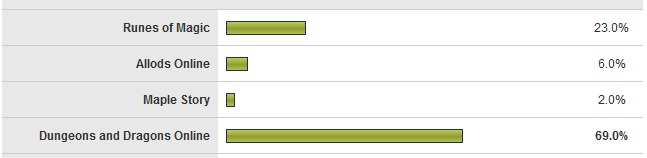
In addition, I should note that these games do not have the same shop system. From the little I have gleaned, the shop in DDO offers mostly cosmetic, unessential items and thus there is very little pressure to buy from it constantly. The only important thing to buy are the content packs which (from what I was to gather from the players,) cost $15 a month or less. On the opposite end of the spectrum, RoM seems to offer items that, while attainable, are extremely valuable and can be very difficult or time consuming to acquire. As such, I believe my results are skewed to show that F2P games require less spending than I thought, because there were mostly DDO players responding, and DDO doesn’t have as strong of a competitive gameplay situation or pressure to buy items. That being said, there are still some interesting results.
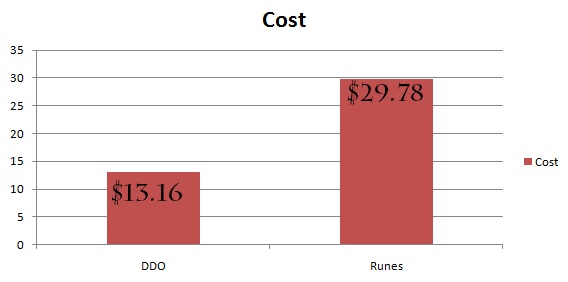
Here is a graph comparing the average amount of money spent per month by players of Runes of Magic and DDO. The other games are left out because of how small the sample was.
Okay, so Runes of Magic players spend, on average (from my limited survey), more than twice as much per month then DDO players. We should also take a look at how causal vs. hardcore gamers spend in comparison.
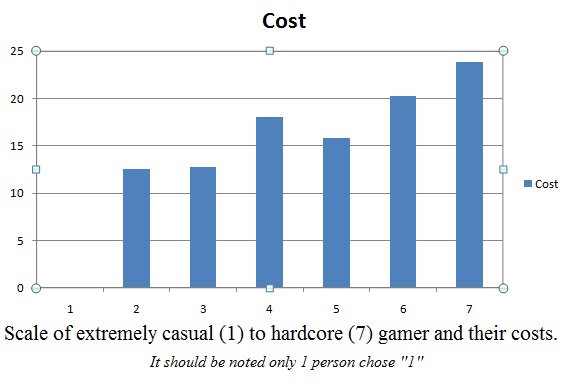 We can see that generally the amount players are spending per month increases with the scale. If you average players from 1-3 (lower end), they spend about $12 a month, where players 5-7 (upper end) spend about $18 per month.
Conclusion:
I will be the first to recognize that there is not a lot of concrete conclusions that I can draw from my data, based on some of the various factors I have outlined already. That being said, I do think that this gives us a good indication that the more one strays from casual playing, the more likely one is to spend, at least, the same as the average pay-to-play (P2P) MMO (which is usually $15/month). In addition, the average cost, per month, for all the players in the survey was $16.78, a small increase over your normal P2P MMO. Personally, I find the F2P model stressful, because I have to choose whether or not to pay money to achieve and equal footing. Instead, on a P2P MMO equal footing is automatic and will not exceed $15 (and indeed can go lower is you pay in larger then one month periods). I should point out that if the store offers purely cosmetic upgrades, I don’t care in the least.
However, I do find one aspect of F2P MMOs very enticing. That is the ability to play them without buying the game itself. I remember dropping $50 on a certain P2P MMO only to find out I hated it. I hope that in the future P2P MMOs will keep their monthly fee but remove the cost of purchasing the game. It would be as easy as playing a trial version and then subscribing in order to continue playing.
My parting thoughts for other gamers: Know yourself. If you know you’re a casual player, you don’t have much time to play, and you don’t care much about getting to the level cap, then F2P MMO should offer you a fairly stress free, cost free gaming environment. However, if you are more like me, and can’t stand the thought of having to work really hard for something that someone can buy in an instant, and don’t want to have to spend extra money, you may want to shift your gaze to P2P MMOs.
When you think about it, paying $15 a month for almost endless fun is probably the cheapest form of entertainment today. Let’s say you spend 20 hours a week online. 20 hours is about the average amount of time that Americans watch TV per week. When I wrote my Psychology thesis on MMOs, I found that typically gamers will replace that time with MMO time. So they typically spent a combined 20 hours doing both. So you spend 80 hours a month online for $15. If you wanted to spend that much time in the movie theater, lets be generous and say it costs 6.50 per movie and each movie is 2 hours, then you would spend roughly $260 to entertain yourself for those 80 hours.
Im in the same boat as you, I really hate F2P mmos where they put vital items up for sale. To me it should only be cosmetic items or items that don’t give you any real advantage against other players. But i guess those wouldn’t sell as much.
I like the idea that I can avoid having to spend endless hours acquiring
items that could give me a competitive advantage. It is so much easier to just
spend the money. My time is worth more that that.